
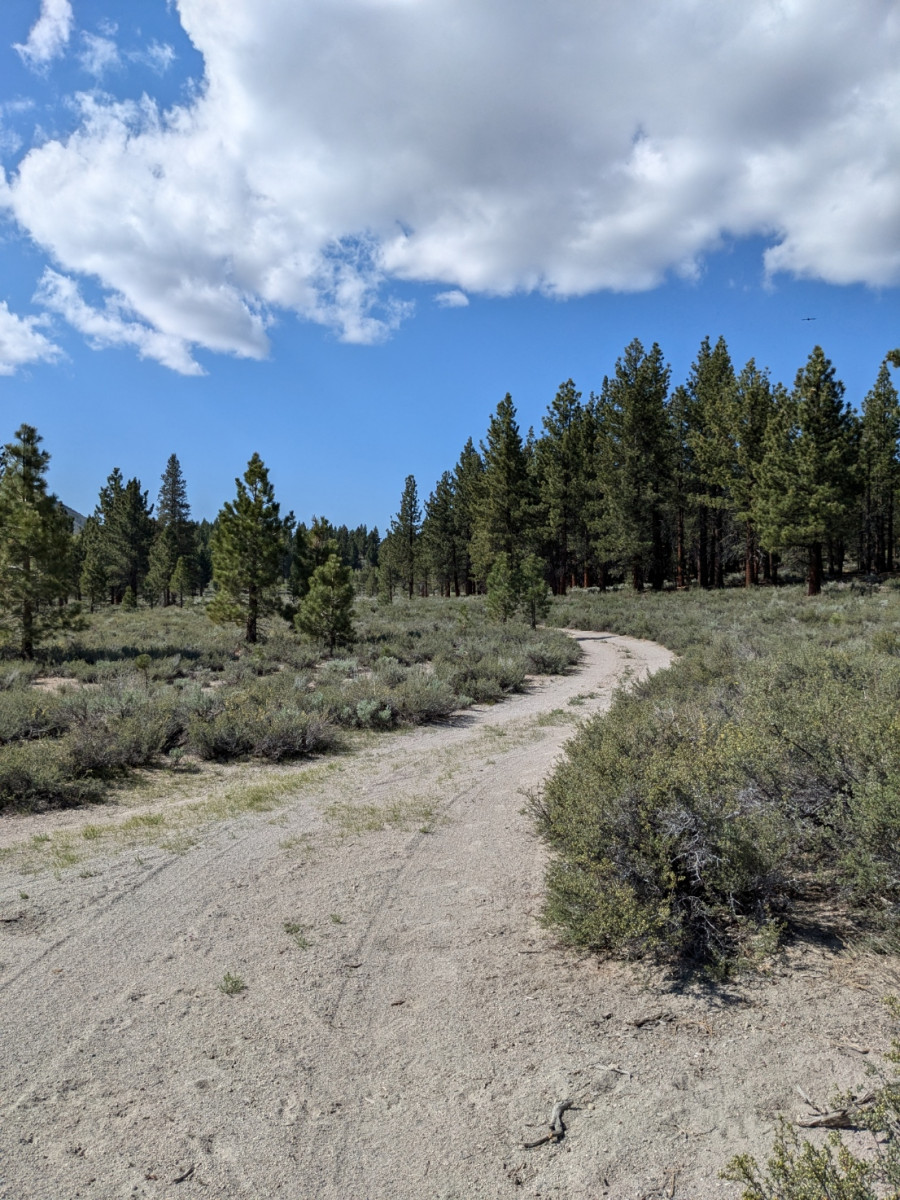
Nestled just south of Mono Lake in eastern California, and north of the dramatic Long Valley Caldera, the Mono Hills beckon with their quiet beauty. These volcanic ridges and valleys are sculpted from pumice soils and lie in the rain shadow of the Sierra Nevada. Yet, against the odds, the slopes burst with stands of Ponderosa Pine, and tucked away in hidden canyons, sparkling springs offer a refreshing surprise to those who venture off the beaten path.
The Mono Hills are a favorite camping spot of mine, with several small campgrounds as well as dispersed camping. I try to stop and explore when I’m in the area, and this year trips to and from Beatty to check my acoustic monitoring equipment provided excuses to stop in June and September.
In June, I made my way to Sagehen Meadows campground. There, a few undeveloped campsites are found along a small creek, surrounded by aspen and willows. Although a few people drove into and out of the campground while we were there, nobody stayed, so the dog and I had the place to ourselves overnight. The bird diversity was remarkable for this desert environment, living up to the adage, “just add water.”

We took a walk in the evening up a ridge on the west side of the campground. I was hoping for a view of the Sierra. The trees were thick enough to make it difficult to see, but I did get a glimpse of the snow-covered mountains above Tioga Pass, in Yosemite, through the trees.

The morning provided a lovely dawn chorus of Green-tailed Towhees, Robins, Mountain Chickadees and others, accented by Williamson’s Sapsuckers and Northern Flickers.
The drive out from Sagehen meadows provided a much better view of the distant mountains on the east side of Yosemite.

I returned to the Mono Hills in September, on my way back from Utah and eastern Nevada, this time staying at Sawmill Meadows. There is a small campground on the slopes of Glass Mountain, an ancient obsidian dome that managed to survive numerous volcanic eruptions associated with the Long Valley Caldera. The elevation here is high, with the campground at 9,200 feet (2800 m), surrounded by lodgepole and limber pine. Despite the altitude and it being mid-September, there was still a large variety of birds in the area, only this time they were doing very little singing and a lot of chirping. And, as is typical in the fall, the Douglas squirrels were busy collecting nuts to stash for the winter and were vocalizing up a storm.
We saw a couple of sheepherders and hundreds of sheep on the way into Glass Mountain. There was another camper at the campground when we arrived, but they left shortly after, and we saw no one else while we were there. It was a lovely quiet night. I had anticipated it to be cold at that altitude, but it was warm enough that I had to throw off some layers in order to sleep comfortably.

I found a small spring not far from the campground and left a microphone there overnight. The spot turned out to be quite a busy place, with lots of activity in the morning. American Robins, Dark-eyed Juncos, Cedar Waxwings, Yellow-rumped Warblers, Red Crossbills, and Mountain Chickadees chirped and flitted while the squirrels fussed.
The loud drumming is a Pileated Woodpecker – quite a treat for this area. After breakfast, the dog and I hiked a short way up the trail to the top of Glass Mountain, but my new knee let me know it was not ready to tackle the whole peak yet. Maybe in 2026.
Discover more from Wild Mountain Echoes
Subscribe to get the latest posts sent to your email.