
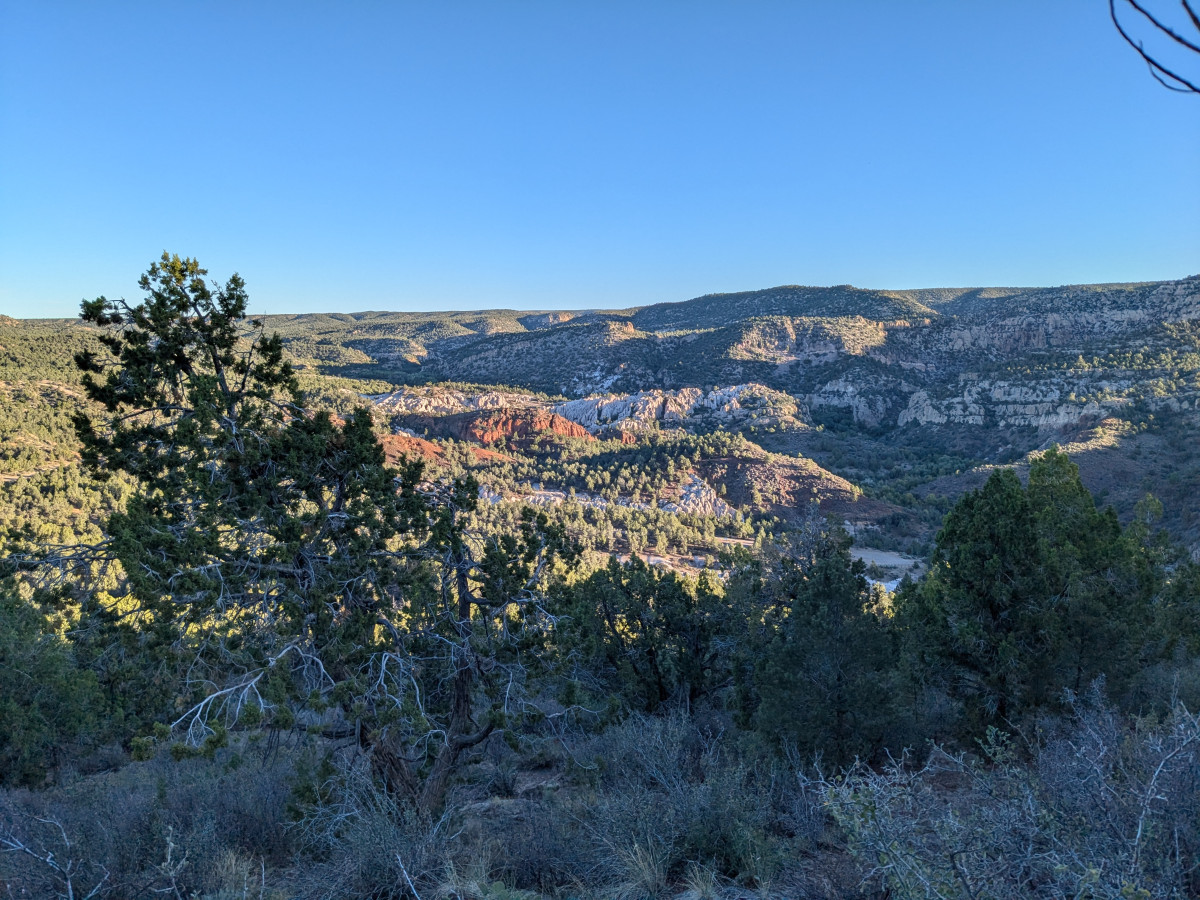
In early September, I set off to check on a couple of my acoustic monitoring stations near Beatty, Nevada (more on that in an upcoming blog post). As I was already on the road, I decided to make a real road trip out of it and check out a spot in Utah that’s been eluding me – Hell’s Backbone. It’s over 400 miles from Beatty to Escalante, the start of Hell’s Backbone Road, so I decided to make a stop in eastern Nevada. On the way east, I stopped at Beaver Dam State Park, where I’ve recorded a couple of times. Ten years ago, I stopped there in the fall and recorded a nice cricket chorus accompanied by a Western Screech-Owl. I was hoping for the same on this trip.
Beaver Dam is not on the way to anywhere – it’s at the end of a long, 25+ mile dirt road. Its remoteness, dramatic tuff cliffs, and thick pinyon-juniper forests attracted me with the potential for good recording opportunities. I arrived in mid-afternoon and had the upper campground all to myself. It was quite windy, and the wind persisted through much of the night (actually for most of the week-long trip). I love the sound of wind snaking through the short pinyon needles, so I set up a recorder at dusk, while hoping the wind would die enough so any owls could be heard.

Unfortunately, I didn’t connect the battery bank correctly to my Zoom F3 recorder, and the on-board batteries died after a couple of hours. But that was enough to get the sound of the wind whipping through the needles (headphones will really help):
I woke up in the middle of the night and rolled out of the car. The crickets were down to their last chirps, and the wind had almost died. It was very, very quiet. No owls, no coyotes. The wind picked up again shortly before dawn and accompanied me to southern Utah.
On the return trip, I stopped near Panaca Kilns, about 15 miles north of Beaver Dam. The topography here is like Beaver Dam, but it is not quite as remote. A small herd of wild horses is known to frequent a spring in the area. I found a nice little camp spot where three canyons came together. I was greeted with one of the largest groups of ravens I’ve ever seen – there must have been at least 30 in the group. According to Google, a group of ravens is called an “unkindness,” “treachery,” or “conspiracy.” I prefer to call them fun to watch.
The hills were covered in pinyons and junipers, with tuff outcrops. The dry canyon bottoms were lined with skunkbush sumac, snowberry, and even some Gambel oak. Even though the washes were all dry, the brush twittered with chickadees, bushtits, and nuthatches.
I took Sage for a walk up one of the canyons. The bottom of the canyon was full of horse tracks (and poop). On top of the horse tracks were the tracks of one large elk. Just as it got dark, I heard a faint bugle high up in the mountains. It’s one of my favorite sounds of fall.

I set up a couple of microphones around camp. It was a quiet evening, with a couple of distant bugles and a few distant coyote yells. When I got up in the morning, I took Sage for a walk up a different canyon and discovered fresh elk tracks heading down the canyon. They stopped about the spot the elk would have seen my car and turned and headed up the hill, very close to where I had a microphone.
When I checked the recordings, I could hear what sounded like antler thrashing, then the elk slowly walked down the hill toward my car. It then paused for a while, before crashing up the hill, circling the microphone and continuing down the canyon. Most of the time it’s difficult to relate what’s on the recording to what’s happening but seeing the tracks helped pull it together. Please use headphones for the spatial effect and listen for the distant sounds of a coyote and Western Screech-owl.
The horses came down the adjacent canyon a couple of hours later, just as the birds and the wind were waking up. Spotted Towhees and Woodhouse’s Jays called, along with ravens, chickadees, nuthatches and bushtits. I was thrilled to hear the calls of a flock of Pinyon Jays moving through.
Pinyon Jay populations have plummeted in recent years. These lovely blue birds have an intimate relationship with pinyon pines and help spread the large, tasty seeds (sometimes called piñons or pignolas). Pinyon seeds make up most of the diet of these nomadic, colonial birds. Every few years, pinyon pines will produce a bumper crop of cones. Pinyon Jays not only feast on the bounty but stash many seeds for future use. And they forget where some seeds are stashed, effectively planting more trees.

Pinyon Pines are fire intolerant – fire usually kills them. Previously, pinyon forests had fire return intervals of 200-600 years, characterized by patchy, stand-replacing fires. Pinyon-juniper forests are replaced with grass and shrubs after a fire, both of which have short burn frequencies, so it takes a combination of a seed source (this is where Pinyon Jays come in), weather conducive to seed germination for trees to reestablish, and a long period free from wildfire. It can take many decades for the trees to start to return, a time frame that is lengthened due to the post-fire invasion of grasses (many non-native) and climate change.

Although pinyon pine-juniper associations are encroaching into some grassland and steppe habitats (in some cases recolonizing after deforestation related to mining), overall, they are declining. Increasing temperatures and repeated droughts stress the trees, making them more vulnerable to insect infestations and resulting in smaller and less frequent cone crops. Over the last 40 years, Pinyon Jays have declined by 85 percent, and the declines continue. They are under review to be classified as a federally Endangered Species.
Pinyon tree seeds (piñons) are also an important traditional food for many tribes in the Great Basin and southwest. Tribes and some conservation groups are actively trying to research and protect the pinyon-juniper forests and the Pinyon Jays, but range managers with the US Forest Service and Bureau of Land Management are still actively decimating large swaths of pinyon-juniper forest, presumably to improve grazing and protect the Greater Sage-grouse.

I have nothing against sage-grouse and spend some time every year trying to record them, but it seems silly to push Pinyon Jays toward extinction while trying to protect the sage-grouse. Or maybe it’s not about the sage-grouse at all?
Pinyon Jay photo by Peter Wallack, CC BY-SA 3.0 https://creativecommons.org/licenses/by-sa/3.0, via Wikimedia Commons
Discover more from Wild Mountain Echoes
Subscribe to get the latest posts sent to your email.